Why Do We Think Olaf is Comic Relief?

This point didn't seem so puzzling to me at first, but as I have pondered the film and its import, I was suddenly struck with this question: why is Olaf not taken seriously as a character? Why is he someone we automatically laugh at, even when he's being serious?
What I came up with: it's not necessarily that Olaf is actually funny all the time. It's that we perceive him as UNREALISTIC, WEIRD, and IMMATURE.
People with Unrealistic Dreams/Goals are Weird
People who have impossible-sounding dreams and goals get merely laughed off; I know from experience, having the career goal of writer/musician/composer/poet since I was a young girl. Nobody took my career ideas seriously--I always got that sort-of mocking half-laugh, and then the immediate question "So what are you really gonna do?" No one believed my dreams were realistic enough to entertain, because they would obviously make me no money. A family member even told me that I would never publish a bestseller or write a famous piece of music, so I had better stop now and do something more "practical."
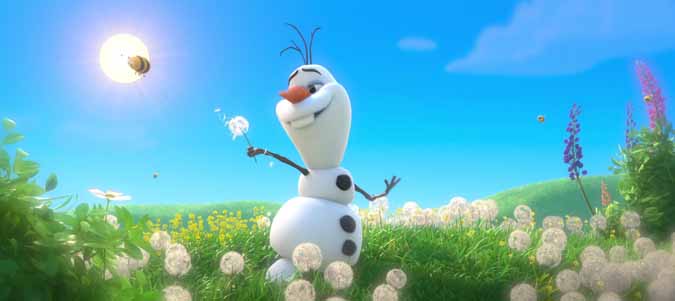
Olaf's grand dream of experiencing summer is met with just as much laughing disdain. Nobody believes he really wants this for himself because he's a SNOWMAN, after all--summer would destroy him! Not to mention that in the grip of Arendelle's eternal winter, summer seems like a ridiculous notion anyway. Thus, he seems utterly silly to us. After all, traditional wisdom asks, what good are big goals that will (probably) never come true?

People Who Don't Display Negative Emotions are Strange
Because sorrow, worry, and anger are so intrinsic to the human spirit, it's hard to understand a character that seems immune to those emotional conditions. Think of Spock from Star Trek: he's even from a different planet with different customs regarding emotions, because his manners of thinking and speaking are so alien to us. Olaf is strange in a similar way--he might express a bit of worry or sadness here or there, but it's always fleeting. No negative event or condition can really shake him for long, even if his head gets separated from his body in a comical way.
This is a definite part of the reason we don't take Olaf seriously; he's got this childlike invincibility that seems unlikely to last long in the "real world." In fact, one almost wants him to be sad so that he'll "snap out of it" and stop being foolish. After all, in traditional wisdom, the "real world" is cruel, and people who don't let its cruelty get to them are just...odd.

People Who Aren't Afraid to be Silly are Immature
Olaf is most certainly silly and happy-go-lucky throughout the film. Some might say he's even too silly. In the "real world," silliness are seen as traits which belong firmly in childhood; "real adults" keep laughing, joking, and other such things to a minimum, especially when it's time for "business." It's part of "growing up."
This is the final reason why we as the audience laugh at Olaf. No one is supposed to be this childish, especially not when they appear to be in an advisory role for young people (Elsa, Anna, Kristoff). He's outlandish as a character because he's arguably a bad example for them, saying silly things when it's clearly time for them to "grow up." Traditional wisdom teaches us that being mature is about being quiet and still, keeping your thoughts to yourself, not appearing too strange so that you don't bother others--thus, we laugh at someone who is so obviously flaunting these social rules.
The Real Problem: Our Misconceptions
I hope my disdain for "traditional wisdom" has come through in my essay thus far (LOL). Though such "common sense" wisdom does have a lot to teach us, I think that in many cases it also blinds us to the beauty of life.
In my view, Olaf's existence and conduct shows us what amazing things can happen when we set aside the silly rules society has placed in our heads. When we allow ourselves as adults to dream big, be silly, and to feel childlike joy again, we bring a lot of the luster back to our days, and we reclaim our lost innocence for ourselves. Considering the state of the world today, I think we might just need an Olaf (or a thousand) to help remind us what we're all fighting for.
